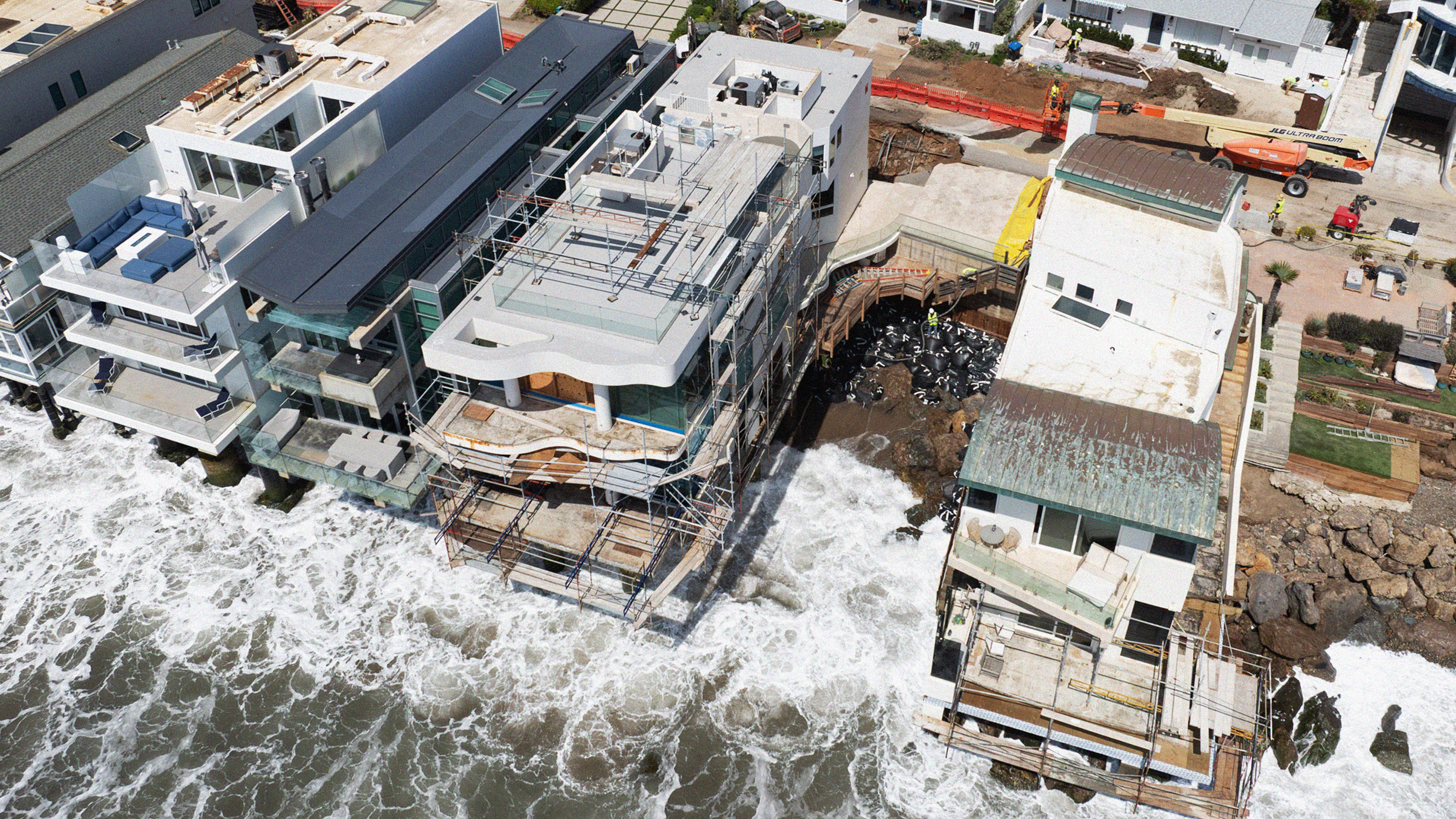
This season, El Niño is offering a glimpse of what the future has in store for California. Engorged with warm water, its waves powered by a frenzy of hurricanes, the Pacific Ocean has been clawing away huge chunks of the coast. Waves overtopped defensive sand berms and tore up the boardwalk on the Long Beach Peninsula, in Los Angeles County. Beaches in places such as Carlsbad, to the south, got wiped clean of sand. Train service to San Diego was interrupted. In Malibu, an access road to Point Dume, a promontory popular with hikers and surfers, partially collapsed from erosion. And on Labor Day weekend, in the driveway of Nicolas Cage’s beachfront home, a small sinkhole opened up.
Francois Navarre, who once ran a paparazzi agency, had moved into the Malibu neighborhood just a few weeks before and discovered the hole while strolling down Sea Level Drive, the private street that runs behind a row of $8 million–to–$10 million homes, perched on pilings, that have an unimpeded view of the Pacific. The Palisades Fire had damaged Navarre’s home in Los Angeles last year, so he’d been living in Colorado. Now he could peer down through the pavement of his new neighborhood to the seawater coursing more than 20 feet below.
The hole grew fast, expanding more every hour, Navarre told me. Gas and water lines soon ruptured. The ocean dislodged the home’s septic tank, which slammed into a neighbor’s home, a security guard for the community told me. Nearly 40 years ago, a coastal engineer had sized up this exact lot and written that the Pacific Ocean posed no threat of washing away the building or its septic system.
Over the next week, the chasm beneath the street stretched below at least four waterfront houses and impeded emergency access to the area, forcing the city of Malibu to red-tag some 30 homes as uninhabitable. Cage did not respond to a request for comment. As an actor, he has infiltrated Alcatraz, navigated underground tunnels, and been pinned under rubble. During this real-life disaster, he was away. Not all of the homeowners in this gated community—a former mayor; the proprietor of a local Ford dealership; the president of the Miami Heat, Pat Riley—live there year-round. The security guard, Cesar Quintanilla, said that among the houses deemed unsafe, only four have full-time residents. When the Red Cross opened an emergency shelter at a nearby high school, nobody showed up.
California’s shoreline faced considerable risk even before this year’s El Niño intensified, when a mass of abnormally warm water in the Pacific Ocean began moving east along the equator. When it hit South America, it cleaved in two, heading south and north. This pulse of warmer water, known as a Kelvin wave, at times this past summer added nearly a foot to tides in Southern California, Jonathan Warrick, a coastal scientist at the U.S. Geological Survey, told me. These conditions also tend to drum up storm activity in the Pacific, and earlier this month, three hurricanes were spinning simultaneously in the ocean. The one closest to California, Hurricane Marie, pushed the swell that hammered the coast over Labor Day weekend.
Sea-level rise from global warming, too, is slowly adding inches of water that are raising the whole system, Warrick said. Malibu’s coastal-vulnerability report, published earlier this year, estimated that 1,410 of the city’s residential buildings—20 percent—plus more than half of the city’s commercial buildings could be affected this century by flooding, seawater intrusion, erosion, or other manifestations of rising seas. Malibu Mayor Bruce Silverstein expects that almost all waterfront structures will be in danger in the decades to come. “Nobody should be buying a home like that unless they can afford to lose it,” he told me.
The victims in this situation don’t always get much sympathy, partly because many people assume that they can afford to swallow the costs. South of Los Angeles, in the city of Dana Point, nearly 20 waterfront homes got damaged or destroyed by high seas, and “we’re getting a lot of hate,” Natalie Driessen, a plastic surgeon whose home in a gated community along Beach Road has been damaged by the waves, told me. “A lot of people are saying, ‘Oh, let the rich homes fall in.’” Buying a home here costs $5 million or much more, but many people live in these houses year-round. Driessen, the daughter of a mechanic and a stay-at-home mom, said that she’d gotten to this neighborhood only after putting herself through medical school and working more than 100 hours a week while she had young kids at home. She said that dismissing the community’s plight is unfair. Even more galling to her and other homeowners is the feeling that authorities have abandoned them to the onrushing waves.
When I visited Driessen’s home earlier this month, several neighbors and their contractors huddled among sandbags on what remained of her mangled patio. Every so often, a wave would thunder against a newly built pile of boulders in front of her house, dousing the group with mist and spray. For years, residents in this community of more than 180 homes on Beach Road have sought permission, in and out of court, from the California Coastal Commission to erect such defenses; many have built barriers without permits. The commission, a powerful state agency, rarely approves such projects: Seawalls can accelerate erosion and prevent the “natural inland migration of the beach,” the agency wrote in a letter to residents two years ago. It warned of potential fines, up to $11,250 a day, for unpermitted barriers. When the waves began ripping into homes in earnest earlier this month, the commission approved some emergency permits for 18-foot-high seawalls. The permits themselves cost $1,600 each, and homeowners rushed to pay the fee, then scrambled to find anyone who could throw down beach boulders in the narrow window between tides.
The coastal commission has warned residents for years about the extreme risk they face living in a FEMA flood zone, one where the beach is eroding by about five feet a year. It “provided immediate and ongoing assistance” to homeowners, including issuing 24 emergency permits for barriers, an agency spokesperson, Joshua Smith, told me in a statement. “While seawalls can provide temporary relief for homes, they can also increase erosion and destroy the public beaches that help protect those same structures,” he noted.
In front of Driessen’s home, contractors had started some of that work before nailing down the price, which, they told the group, could amount to more than $100,000 a home. Driessen didn’t see any alternative. “Just build the wall,” she told the contractors. “Build the wall.” In the longer term, Driessen and her neighbors want regular injections of fresh sand and a revetment—a sturdier, continuous barrier down the coast—but they have little guarantee that anything will change. In fact, the commission told homeowners that they’d have to remove within 120 days the boulders they’d already put down—again at their own expense—if the commission did not approve permits for a more permanent solution. The deck, kitchen, living room, and game room of Chris Rogers’s beachfront home got consumed by the waves before the contractors he’d hired could pour out concrete to defend the house. To save the rest of it, he told me, “we need immediate help.” Among the last homes to fall into the sea earlier this month, he said, was one whose owners had been in years-long talks with the coastal commission for protection.
The most intense months are likely still to come. El Nino’s supercharged storms could soak parts of the state with heavy rains. Los Angeles is clearing storm drains and mountain reservoirs to try to prevent flooding. Up and down the coast, bulldozers and heavy machinery are moving rocks and building berms. In areas burned by wildfires, heavy rains can trigger landslides. The extreme weather is already clearing away the coastline. Driving down the Pacific Coast Highway in Malibu, I passed mile after mile of empty lots and the ruins of waterfront properties that burned in last year’s Palisades Fire. Of the roughly 300 homes along the beach that burned, none has been rebuilt. (The mayor told me that only 31 of them were owned by people who used them as their primary residence.)
The people with multimillion-dollar homes on the beach may be making the most obvious sacrifices to El Niño, but all Californians are paying for damages. The residents on El Niño’s front lines have been peppering their elected officials with pleas for help; a bipartisan group of state legislators wrote to Governor Gavin Newsom asking him to declare a state emergency, which he did last week. Disaster in even the wealthiest enclaves can demand government resources. Taxpayers bear the brunt of repairs to infrastructure and public roads. Although many people want regular infusions of new sand and barriers, such solutions can overwhelm city and county budgets and cause unintended consequences elsewhere. Yet if the coast erodes away, everyone loses. Sandy beaches are an economic engine for Southern California, and denuding them drives away visitors.
Few Californians want to face the prospect that beachfront homes may simply no longer be viable along stretches of the coast. Of the more than 180 homes on Beach Road in Dana Point, “I wouldn’t say all of them are vulnerable, but most of them would be,” John Gabbard, the city’s mayor, told me. “There’s going to be a very difficult long-term discussion about how do we protect—if we protect at all—homes that are built on the beach.”
On two occasions in recent years, State Senator Ben Allen, a Democrat who represents Los Angeles County, has put forth legislation to create a loan program for local governments that want to buy beachfront homes and then rent them out to cover the cost of the program until the time comes to demolish them. Newsom vetoed it both times. “We have these beautiful coastal homes that are a part of California life. And we’ve all gotten used to this idea that people can live right up against the water and have these spectacular sunsets and have dinner with your toes in the sand,” Allen told me. But to him, how much society should pay to battle the sea is an open question. At some point, surely the price of building doomed houses is too high.
For the moment, the reality of California’s coasts is that Francois Navarre, in one of the most desirable seaside enclaves in the world, is schlepping five-gallon jugs of water under the Malibu sun; he has no running water amid ongoing sinkhole repairs. He and his neighbors cannot rest easy. Another Kelvin wave, the largest and warmest one of the year, is making its way up the coast of Mexico and is expected to hit Los Angeles early next month. The king tides, the highest of the year, are landing around Thanksgiving and Christmas, and they happen to be the highest in an 18-year cycle. If more El Niño–juiced winter storms arrive, the ocean will almost certainly claim more homes. “They say that this is barely starting,” Quintanilla, the security guard, said. His job is to protect Sea Level Drive, but he cannot protect it from everything.