So long, summer recess. Today’s “long conference” – the subject of this morning’s Closer Look – marks the unofficial start of the 2026-27 term. (The official start is the first day of oral arguments on Oct. 5.)
At the Court
On Friday, the Supreme Court cleared the way for the Trump administration to use a modified version of the Department of Homeland Security’s Systematic Alien Verification for Entitlements database to identify noncitizens on state voter rolls. Justice Ketanji Brown Jackson wrote a dissenting opinion, joined by Justices Sonia Sotomayor and Elena Kagan. For more on the decision, see the On Site section below.
Also on Friday, the Supreme Court, for the third time, declined to allow Missouri to use a congressional map expected to aid Republicans in November’s elections. There were no public dissents. Learn more about the decision in the On Site section.
On Thursday, the Trump administration asked the Supreme Court to intervene in a battle over third-country removals – that is, the removal of noncitizens to countries not identified in their removal orders. A response to that request is due today by 4 p.m. EDT.
As noted above, the justices will meet today at the “long conference,” where they will consider petitions for review that built up during the court’s summer recess.
Unknown block type "paywallDivider", specify a component for it in the `components.types` optionMorning Reads
NYC’s high school affirmative action policy challenged in Supreme Court
Stephen Dinan, The Washington Times (paywalled)
Last week, a New York City mother, Yi Fang Chen, “asked the Supreme Court to step in and order her son be allowed to take a seat at the selective Stuyvesant High School, saying he’s being blocked by affirmative action policies that punish him for being Asian American,” according to The Washington Times. “Stuyvesant generally offers admissions based strictly on the results of an exam, but it allows some students to enter based on its ‘Discovery Program,’ which applies to economically disadvantaged students whose test scores are close but below the cutoff line.” After an update to Discovery Policy program rules in 2018, “Discovery seats went from about 3% of enrollment to 20%, and the program was limited to certain middle schools,” Chen asserts, contending that race drove the changes. Chen claims that, by taking more spots at the school, the updated Discovery Program kept her son, who “scored a 558 on the entrance exam, just shy of the 561 cutoff,” from being admitted. “Chen has asked the justices for an emergency ruling allowing her son to attend the school while the case proceeds.”
Jackson says all is not well on the Supreme Court emergency docket
Kelsey Reichmann, Courthouse News Service
During a Thursday speech at the University of the District of Columbia School of Law, Justice Ketanji Brown Jackson reflected on the state of the emergency docket, “describing what she viewed as corrosive harms caused by the high court’s current use of quickly issued and often unexplained orders to decide controversial cases,” according to Courthouse News Service. “Our modern methods are not serving the court or the country well,” she said. “I hope it’s also clear why I adamantly reject any effort to normalize a process whereby the Supreme Court actively superintends matters that are pending in the lower courts.” Jackson spoke about the interim docket as a whole rather than “one specific decision,” asserting that “the court wasn’t adhering to a consistent set of standards for all applications.” “If we’re not careful, the emergency docket can and will become an end-run around the standard review process, a special avenue that certain privileged litigants can use selectively,” Jackson said.
Appeals Judge Says Justices’ Emergency Orders Can Lack Guidance
Jordan Fischer and Justin Wise, Bloomberg Law
During a Saturday event hosted by William & Mary Law School, Judge David Stras of the U.S. Court of Appeals for the 8th Circuit “said the Supreme Court is sometimes placing lower courts in uncertain positions by issuing emergency orders with too little explanation,” according to Bloomberg Law. “They release these short orders that are sometimes really unclear to the circuit courts,” said Stras, who recently sat on the 8th Circuit panel that considered the dispute over redistricting in Missouri. However, Stras added that the Supreme Court is “often in a hard position,” because there are often “good reasons for writing more or writing less. “I don’t know where the happy medium is.” Stras explained that “it would’ve been ‘incredibly helpful’ in the Missouri case for the justices to explain what, if anything, was left for the lower courts to decide after the Supreme Court stayed an order directing the state to use a redrawn map favoring the GOP earlier this month.”
Appeals court rules that states can regulate Kalshi’s sports prediction markets, dealing another legal blow to platforms
Davis Giangiulio, CNBC
On Friday, the U.S. Court of Appeals for the 6th Circuit ruled “that states have a right to regulate sports-related event contracts on prediction market platforms, marking a second major legal defeat for the industry as a fight at the U.S. Supreme Court looms,” according to CNBC. The platforms also lost before the U.S. Court of Appeals for the 9th Circuit, which “ruled last month that Nevada has a right to regulate sports-related event contracts.” “Meanwhile, the 3rd U.S. Circuit Court of Appeals ruled against New Jersey in April and said the” Commodity Futures Trading Commission, a federal agency, “has the exclusive right to regulate” the prediction markets’ offerings. “New Jersey appealed that decision in a petition to the Supreme Court earlier this month. It is not clear whether the Supreme Court will take up the case now, or wait until further decisions from circuit courts on the issue of sports-related event contracts are delivered.”
The Most Likely Avenue for Supreme Court Reform
Simon Lazarus, The New Republic
In a column for The New Republic, Simon Lazarus reflected on the surge in interest among Democrats in Congress to reform the Supreme Court and explained why he believes they should focus their reform efforts not on adding justices or imposing term limits but, instead, on “enacting a sensible but enforceable code of ethics for Supreme Court justices.” According to Lazarus, “[s]uch a proposal is eminently defensible on the merits. Supreme Court justices are the only officials in the federal government, including all lower court federal judges, who are not subject to a meaningful code of conduct. Substantial popular majorities, including multitudes of Republicans, support legislation to plug that gap.”
On Site
Court News
Supreme Court clears way for Trump administration to use modified voter verification database
The court on Friday cleared the way for the Trump administration to move forward with its plan to use a modified centralized database to verify voters’ citizenship. In a seven-page opinion, the justices paused a ruling by a federal judge in Washington, D.C., that had blocked the government from doing so on the ground that it violated (among other things) federal privacy laws.
Court News
For the third time, Supreme Court declines to allow Missouri to use congressional map expected to aid Republicans
The court on Friday declined to allow Missouri to use a new congressional map, intended to benefit Republicans, in the November 2026 elections. In a five-page, unsigned order, the justices paused a ruling by a federal appeals court in St. Louis that had directed the state to implement the new map.
From the SCOTUSblog Team
The funniest justice of the 2025-26 term
The results of Nora Collins’ laugh analysis for the 2025-26 term won’t come as a surprise if you read her laughter project last year. Justice Neil Gorsuch retained his title as the funniest justice, earning far more laughs than any of his colleagues.
From the SCOTUSblog Team
The High Court of Australia
For SCOTUSblog’s series on different supreme courts around the world, Zach spoke with Cheryl Saunders of Melbourne Law School about the High Court of Australia.
A Closer Look
The Long Conference
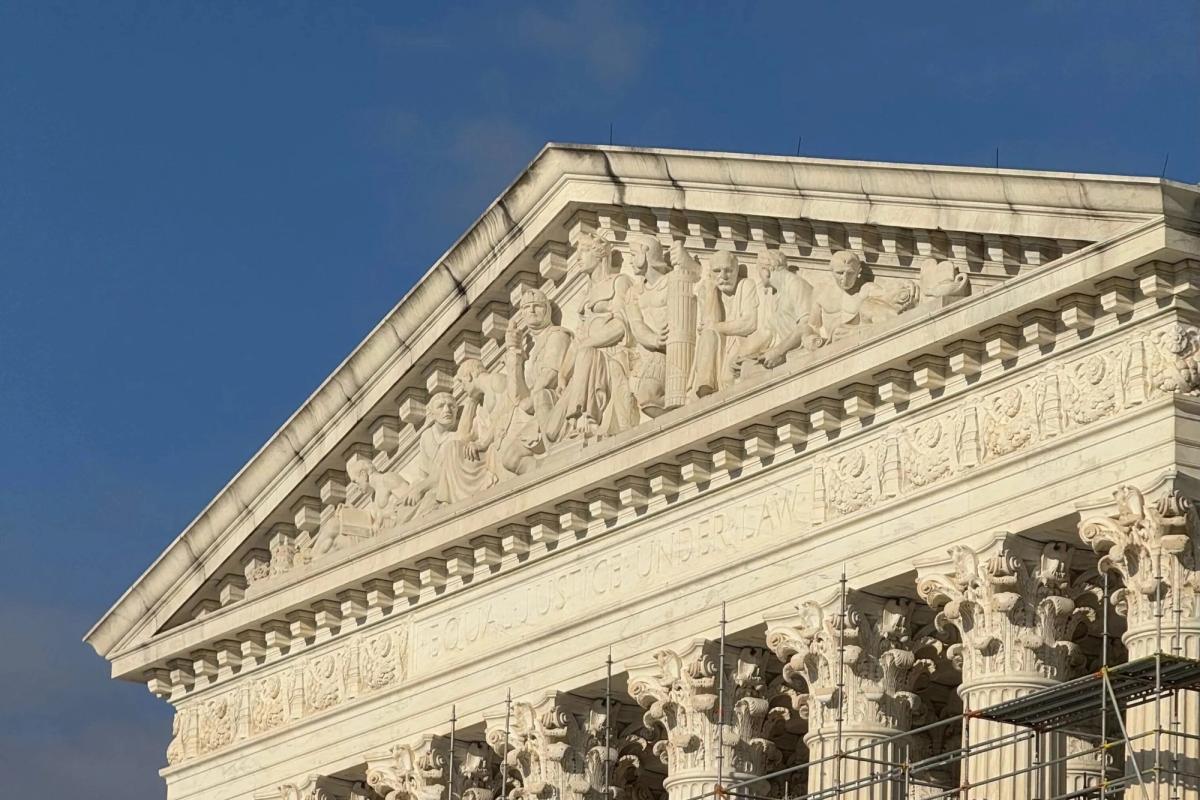
We may still be one week away from the first Monday in October – the official start of a new Supreme Court term – but today will be a busy one at One First Street, as the justices come together at their annual “long conference” to consider petitions for review that accumulated during the court’s summer recess.
Why is it called the long conference? Because there’s a lot of work to do. Roughly 2,000 petitions are assigned to this conference each year, and most of their fates will be decided by the end of today’s meeting.
To be clear, they don’t go one by one down a list of 2,000 cases during the long conference. Instead, as Amy noted in a story last year, the justices only consider the petitions that one or more of them have flagged for the “discuss” list – the list of cases the justices will actually talk about and vote on – after hearing from clerks about which petitions may warrant Supreme Court review. The petitions that don’t make it through this screening process are essentially denied before the long conference even begins.
Still, there will be much to discuss at today’s meeting, and, if recent years are any indication, several petitions will be granted. Over the past three terms, the court has taken up between five and 15 long conference petitions for argument.
We have highlighted nine disputes in this newsletter that the court will potentially take up, including petitions asking whether schools may ban students from wearing “Let’s Go Brandon” sweatshirts, what types of discovery orders are appropriate in lawsuits over access to government information, and how the Eighth Amendment’s ban on “cruel and unusual punishments” applies in the context of sentencing juvenile offenders to life in prison without the possibility of parole. We’ve featured other long conference petitions in articles on cases brought to the court by the Trump administration.
If the court follows its traditional routine, we will learn the fate of most of these and other long conference petitions within the next week. For the past three years, the court has released a list of the cases granted during the long conference on the Friday after the conference took place. Then, on the following Monday, the court has issued an order list with the many, many petitions that were denied. In other words, this year, we’re watching for a list of grants on Friday, Oct. 2, and an order list next Monday, Oct. 5, the first day of the 2026-27 term.
The justices’ next private conference – which will involve a smaller group of petitions – is set to take place on Friday, Oct. 9.
SCOTUS Quote
JUSTICE SCALIA: “There seems to be a rational line between collateral attack and attack in the same proceeding. I don't see anything irrational about that. Right?”
MR. CATTANI: “No –”
JUSTICE SCALIA: “Yes!”
MR. CATTANI: “Yes, I agree. Yes.”
— Martinez v. Ryan (2011)